Broad St. circa 1912 with the Wiss Building (completed in 1911) towering over Military Park.
The Wiss Building under construction on 8 June 1910.
1913.
1914.
Circa 1915; the Wiss Building now has a billboard on the rooftop. Painted signs on side have changed. The Goerke Store, the white building in the center left, was built 1912-1914. The 1923 S. Klein On The Square store has not yet been built. It would be between the Goerke Store and the Wiss Building.
Goerke, Wiss Building and Hahne & Co. circa 1915.
Hahne & Co. seen from Rector Street, on 15 May 1924, on Broad Street now overrun with cars. The Wiss Building is in the distance.
Boys selling newspapers in front of Hahne & Co. on Broad Street in 1924.
Snow on the ground...
Goerke, Wiss Bldg, Hahne & Co. in 1929 or 1930.
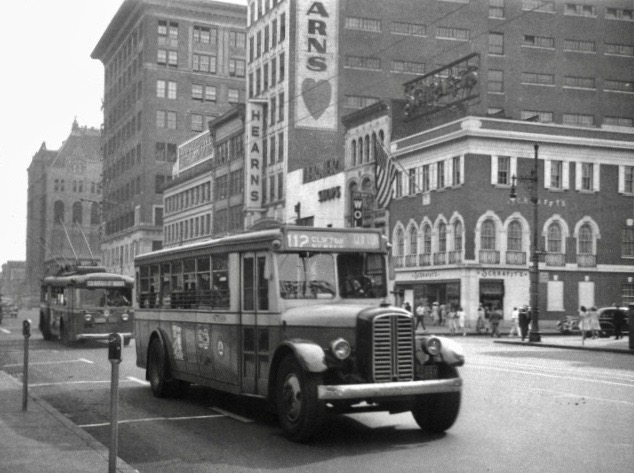
Richard Wesley wrote in FB: I’m guessing it’s sometime in the early 40s, judging from the busses and cars, the vertical section of the Loews' marquee, that big sign atop the Griffin Piano building and what appears to be a War Bonds display in Military Park.
Broad Street in the 1940s.
Broad St. in the early 1940s with Hearns (1827-1955) and Schrafft's on the corner of New Street.
McCrory's, Hearns & the Wiss Bldg in 1945.
Trinity & St. Philip's Cathedral (Episcopal Church) 1940s.
McCrory's in the
1950s.
.jpg)
Broad St. and Raymond Boulevard in 1949.
Broad St. with Raymond Boulevard in 1952.
1940s.
Broad St on 13 April 1956, with Kresge's , McCrory's and S.Klein on the square on the left.
Halsey Street circa 1959, with Kresge on the right-hand side.
Kresge Department Store; 9 floors plus a basement.
Kresge on the corner of Broad Street & Raymond Boulevard in the 1950s.
Kresge-Newark was an upper-middle market department store based in Newark, N.J. The firm was started in the 1920s when its founder Sebastian Kresge purchased the L.S. Plaut Department store in downtown Newark and rebranded the business Kresge-Newark. This store had no management connection to the S.S. Kresge. Sebastian Spering Kresge (*31st July 1867 + 18 October 1966) was an American businessman. Kresge and his family were members of Detroit's North Methodist Episcopal Church. He held membership in numerous organizations including four Masonic lodges and the Ancient Arabic Order of the Nobles of the Mystic Shrine etc.
He created and owned two chains of department stores: the S. S. Kresge Company, 5 & 10 chain based in Detroit, Michigan and the Kresge-Newark traditional department store chain. The discounter was renamed the Kmart Corporation in 1977.
Kresge was born near Allentown, Pennsylvania, the son of Sebastian Kresge and the former Catherine Kunkle. Living on the family farm in Kresgeville (named for his ancestors) until he was 21 years old. Following his graduation, he clerked in a hardware store for 2 years, then worked as a traveling salesman from 1892 to 1897. On March 20, 1897, Kresge began working for James G. McCrory, the founder of J.G. McCrory's, at a 5-&-10-cent store in Memphis, Tennessee. He continued there for two years.
In 1899 he founded his own company, with Charles J. Wilson, with an $8,000 investment in two five-and-ten-cent stores; one was in downtown Detroit, Michigan, for which he traded ownership in McCrory's. In 1912, he incorporated the S.S. Kresge Company with 85 stores. During World War I, Kresge experimented with raising the limit on prices in his stores to $1.
In 1923, he again started a new company, buying out L.S. Plaut & Co., a large traditional department store in Newark, New Jersey. He renamed the store Kresge-Newark, expanded it, and started branch stores. The new department store company was completely independent from the S.S. Kresge discount department store company.
In 1926, Kresge replaced the original Plaut store, nicknamed "The Bee Hive," which had been built in 1891, with a larger flagship store that occupied the entire city block, between Broad and Halsey streets, and Cedar Street and Raymond Boulevard. It had 9 stories plus a basement store. Such was the store's prominence in the city that in 1927 it arranged to have an underground streetcar platform opened at its basement level, allowing customers to come in directly from streetcars; the only access was through the Kresge store on one side of the platform and McCrory’s on the other side.
The firm positioned itself between its popular priced rival, Bamberger's, and its more upscale competitor, Hahne & Company. Kresge was the last of Newark's department stores to remain independent, and its customer loyalty was fierce. During the Christmas selling season, Kresge's operated a monorail ride around its toy department, and its Breakfast With Santa sold out early each season.
Kresge-Newark also took a lead in many civic improvements and was active in the early planning of the Gateway Center (which opened long after the store's demise). The store also formed an alliance with Asbury Park-based Steinbach.
In 1964 with it clear that his heirs had no desire to take over the department store business, the Kresge Foundation sold the stores to David Chase, and they were rebranded Chase-Newark. In 1967 Chase-Newark announced it was closing, and four selling floors of the Newark flagship were leased to the Two Guys chain. The two branch stores were closed at this time and the downtown Newark location reopened as a Two Guys unit in the fall of 1967.

Loew's Theatre on the corner of Broad St. & New Street, on 13 January 1957 shows Victor Mature in 'Sharkfighters' and 'The man from Del Rio'.
Loew's Theater on Broad Street in 1949.
Schrafft's, Bulova's clock on top of Jordan's, Wiss Jewlers, Loew's playing 'Don't go near the water' with Glen Ford in December 1957.
Paul Kokosinski wrote at FB in 2025: this is the corner of West Park and Broad Street. The building was a bank in its last life in the 80’s. David O'Hara wrote: Broad Street, Newark, now sits the new Prudential building.
Newark's 1952 bird's-eye-view with the Court House and Market St in the foreground. 
Broad Street in 1958; Jack Conway wrote at Facebook: I started working at Pru in August 1956, and they were just beginning to tear down the North building to replace it with the Plaza. They also had auctions of the office equipment prior to demolition, and I got 4 Board room chairs for 20.00 and are worth over 500.00 today. I had a chance to walk through most of the North Building including the Gym on the top floor and the Board room with its wood paneling from the Black Forest in Germany; the Marquee on the Loews is playing "Torpedo run" starring Glenn Ford & Ernest Borgnine; release date 24 October 1958.
Jule Spohn wrote: You can see the PUBLIC SERVICE sign behind the trees on the left.
downtown Newark, 1947.


.jpg)


.jpg)
.jpg)


.PNG)


.jpg)


.jpg)


.jpg)



.jpg)

.jpg)

.jpg)

.jpg)


.jpg)


.jpg)