Monday, 15 June 2020

Kutsher's Country Club, Monticello, N.Y.

Wilt Chamberlain (*21 Aug 1936 +12 Oct 1999) & Helen Wasser Kutsher (*11 July 1923 +19 March 2013) at Kutsher's Country Club where Wilton Norman worked as a bell-hop.
Wilt Chamberlain, Kansas, 1955.
Kutsher's basket ball team entertain guests.
Kutsher's bellhop squad from the shortest to the tallest (Wilt).
Wilt Chamberlain as a bellhop at Kutsher's in the summer of 1954.
Kutsher's dining room staff  pose for an annual picture in 1964. Much of the wait staff was made up of students working summer jobs to help pay for college or graduate school, appealing to the daughters of guests, just like the not-so-trustworthy Max Cantor character in "Dirty Dancing."
Ron Maxman, Bruce Bleieiss, Fassberg, Barry Gold, Unknown at Kutsher's D.R. summer 1978.
Broadway, Monticello in the 1950s.
Monticello in the Summer of 1964. The Rialto plays Edward Dmytryk's 'Carpetbaggers' with George Peppard & Carroll Baker.
The Broadway on Broadway, Monticello. Photo taken in 1989. 
The Broadway marquee more recently...

Monticello's principal thorough-fare was Broadway. The main street through the town was widened and lined with restaurants, hotels, and movie theatres such as the Art Deco Rialto.

Today however, most of the grand buildings found on Broadway are shuttered and closed. The old red brick buildings and store fronts are redolent of an Edward Hopper main street, but for all its charming vintage look, it is hard to shake off a melancholy air of decline.

The Rialto itself was torn down about a decade ago. For a while its evocative marquee and front was kept on Broadway, although that has now gone as well. 
Sullivan County Trust Co. in Monticello, N.Y. 

We’ve made a few trips to explore the abandoned resorts of the Borscht Belt of New York. Once places like Grossinger’s, the Concord, Kutscher’s , the Nevele and the Pines, were the epitome of a swanky summer holiday for New Yorkers. All through the Catskills were dozens of all-inclusive resorts, glitzy enough to entice the mostly Jewish, upper-middle class holiday makers from the city, and today virtually all of them have either been torn down, or lie in ruins. But if you were spending your summer vacation in the Borscht Belt, chances were you made your way through the town of Monticello. So what happened to the town at the centre of them all?

We went to go explore old, historic Monticello, to discover a town that has struggled since the heyday of the 1950s, but with light at the end of a tunnel in the form of a new casino.

Named after Thomas Jefferson’s plantation home, Monticello can be found a few hours north of New York City. The largest town in Sullivan County, during the 1940s and 50s – the peak years of the Borscht Belt – tens of thousands would pass through the picturesque town every week. 

A harness horse racing track opened in 1958, nicknamed the Mighty M. As the Borscht Belt thrived, the area attracted the likes of Woody Allen, Elizabeth Taylor and Mel Brooks. So many people passed through Monticello, the town became known as the ‘Gateway to the Catskills’.

Monticello Inn-Hotel in the 1940s.
Monticello Inn-Hotel in the 2020s.
Monticello business section in the 1800s.
Sullivan County & vicinities in an old map... when Woodridge was called Centreville.
Helen Wasser Kutsher
article written by Steven Israel

It was never the biggest of the Catskill resorts, nor did it have the international acclaim. And it wasn’t Jerry Lewis’ favorite place.

And while other hotels touted their enormous dining rooms, multiple golf courses and outdoor pools and maze of corridors leading to more than 1,000 guest rooms, Kutsher’s Country Club countered with the gracious handshake, warm smile and motherly care from hotel matriarch Helen Kutsher. No resort owner could make any guest feel more at home.

And now amazingly – and many would say sadly – Kutsher’s has become the last of what is estimated to have been nearly 1,000 hotels in the Catskills during the heyday of the 1950s.

What began in 1907 when brothers Max and Louis Kutsher started taking in guests at their small rooming house on 200 acres evolved – guided by the keen business mind of Louis Kutsher’s son, Milton – into a 1,500-acre resort empire with hotel, condos and sports camps. It survived the most turbulent years a century later under the watchful eyes of Milton and Helen’s son, Mark.

How did they do it?  

With a lot of lox, a lot of luck and a lot of love.

In 2007 I was able to convince Helen Kutsher to take some time away from her guests and talk about her life, her Milton and her hotel, which was celebrating its 100th anniversary.

Do you remember your first summer at Kutsher’s?

It was 1934. My mother died a year and a half before that. I came up with my father’s friends, who didn’t want my brother and I to be in New York alone in the summer. We spent several weeks at Kutsher’s. I was 10.

How did you meet Milton?

I knew Milton since I was 10. My stepmother (Rebecca Kutsher) – I never called her that – was his aunt. She was married to Max Kutsher. My mother-inlaw and my mother had it worked out. There were four boys in the family: Milton, Joe and the Bogner boys, Mannie and Carl, who were cousins. They figured, “Helen has to be for someone; we have to keep her in the family.” I made a wise choice. Milton and I both made a wise choice. This year we would have been married 61 years.

And you helped run the hotel?

Not bad for a shy, introverted girl. My mother kept saying, “There’s nothing you can’t do” and Milton agreed with that.

No one would call you a shy, introverted girl now.

No, but that’s from their influence. My mother used to disappear every day at about 12-12:30 so she could go shopping. But she would disappear so I’d be forced if a guest came to greet them. I’d stand for a while, hoping they’d go away. They broke me of my shyness. Forced me into doing things I never would have done. Like giving them a strong handshake. My mother said, “Reach for their hands. Look in their eyes. People need to know that you are paying attention to them.”

And you know their names.

It’s getting a little harder to remember, so I check our arrival list every day, who’s coming in, what they like. If we need to send them food, send them wine. And greet them. They’re part of my family. I also use a book I’ve had for 50 years. It’s got information about guests and our staff. Birthdays, anniversaries, what people want. God forbid I should lose the book.

How did you balance being a mother and hotel matriarch?

It’s not easy. Not easy at all. I thought it was normal to work 23 hours a day. We always ate our dinners together. Breakfast was a fast deal. We did have a chauffeur, Murray, who lived with us. He’d get the bagels, take the children to school and watch over them. They resented it. They’d say, we can’t do nything; Murray’s watching us. That’s how we survived.

Are there times when you just want to lounge around in a bathrobe?

That luxury I never had. But now, after all these years, I eat breakfast at home, which I never used to do. We all grew up like that. If you married a hotel man, and you weren’t a working wife, something was wrong. I’d say, “She really hates the business,” because how can you be there and not be active in some form?

What did you want your role to be?

I just worked my way into it. (Laughing). They’d be talking of women’s lib. I didn’t even know what it meant. I went to Milton, “What are they talking about, women’s lib?” He said, “That’s what you’re doing.” Hotel women were an essential part of the business. Milton couldn’t do it all.

They say Catskill guests can be tough.

(As I ask Mrs. Kutsher, two guests interrupt to say hello to her.) They check their room. If they’re used to 810, they don’t want 811. They say, “That’s my room. My room.”

You give pep talks to the staff?

Every Monday I’d go into the dining room and talk with all the waiters and busboys. They were all going to college. I told them, “I know you’ll be a doctor, a lawyer ... whatever your profession. But if you want to be successful in whatever your purpose is in life, you have to be a successful busboy and waiter. That’s what will follow you through life. This is important. It forms your thinking.”

The hotel was always updating.

I’d be handling reservations and people would call and ask, “Do you have an indoor pool?” We didn’t at the time. But Milton said, just tell them eventually we’ll have one. This year we’re building a golf course and next year we’ll have an indoor pool. I remember selling a room in the main building that wasn’t built yet. Milton said sell the first two floors of the main building and we’ll have it built.

Can you believe, 100 years?

People ask, “Have you been there all the time?” I say, “No, I skipped a few years when I went to school.” It goes over their heads.

How has Kutsher’s survived?

There was a very personalized feeling here. Guests felt they were coming home. They could have gone to the Concord or anywhere else, but they would be just another guest. Our people didn’t want that. Each hotel was different, each one pretty good in its own right. Every hotel had its own personality. And you’re the personality of Kutsher’s. My grandson says, “You’re the eyes of the hotel, Nanna.”
Helen Wasser Kutsher in 2007, when the Country Club became 100 years old. Helen died 6 years later on March 2013, at age 89.
Mark, Helen & Milton Kutsher. 
Helen Kutsher at a night club function.

Monticello - Helen Kutsher, matriarch of the last family-run resort in the Catskills, was remembered Thursday, 21st March 2013, both as the warm-hearted mother, grandmother and friend, and legendary hotel owner called simply "The Best."

More than 250 friends, former guests and family attended Mrs. Kutsher's funeral at the Landfield Avenue Synagogue in Monticello. Her son, daughters and grandchildren told the assembled that she loved her guests for more than 50 years, and her family even more. Mrs. Kutsher died Tuesday at a hospital in Philadelphia. She was 89.

Her son, Mark, and daughters, Mady Kutsher Prowler and Karen Kutsher Wilson, recalled how Helen Kutsher had to overcome a tough childhood. Her mother died when she was 10 and she came to the Catskills one summer. She was soon taken under wing by Rebecca Kutsher, who later married Helen's widowed father. Helen worked at Kutsher's before World War II and then married Milton Kutsher, Rebecca's nephew, when he returned from the war. Helen soon became the face and personality of the resort as it grew to one of the largest in that era.

Stories abounded about Mrs. Kutsher's sharp wit, grit and warmth. She met her guests at the door with a firm handshake, always immaculately dressed in a scarf, her hair always neatly coiffed.

She never forgot to send a birthday card. When her health started failing and her friends stopped getting regular birthday cards and greetings, they would call the family and ask if she was OK.

One of the biggest laughs at the funeral came when Mark Kutsher said his mother, when she was a student at SUNY Delhi, did an internship — at Grossinger's, which was Kutsher's great rival at the time. Mark Kutsher said the families were actually friends. When she showed up to do the internship, the Grossingers offered to let her stay in a fancier room.

"She said, 'No, I will stay with the staff,'" Mark Kutsher said. "That was part of the woman she was."
Helen Kutsher was known as a stickler, greeting her guests at the door by name and walking the halls, picking up bits of paper from the carpet so the place would be spotless. "She was a schmoozer extraordinaire," said her grandson, Matthew Prowler. "But it wasn't an act."

In summer 1954, a high school basketball star named Wilt Chamberlain worked as a bellhop at Kutsher's Country Club by day, and at night played on the resort's basketball team made up of top college talent. The Kutsher's team, led by then-Kutsher's athletic director and Celtics legendary coach, Red Auerbach, would compete against the teams of other Catskill hotels to entertain the guests. For Chamberlain, it was the beginning of a life-long friendship with the Kutsher family.
Milton Kutsher & Louis Armstrong sometime in the 1950s. 
Milton Kutsher's thombstone.
How to reach Kutscher's Country Club by car from NYC and Metropolitan Area: (less than 2 hours) George Washington Bridge to New Jersey Palisades Parkway to New York State Thruway North.  Proceed on Thruway to Exit 16 and proceed on Quickway, Rt 17, to Exit 105-B. Turn left at first traffic light and follow signs to Kutsher's. 
Robert Cohen & Tony Luis working at the Fallsview Hotel in 1958. 
Robert Cohen mingling with guests at Fallsview Hotel in 1959.
Tamarack Lodge's dining-room staff circa 1960 - photo credit by Robert Cohen who lived in Ellenville and worked the Fallsview, Homowack, Tamarack, Gilbert's and more.

Borscht Belt, or Jewish Alps, is a colloquial term for the mostly defunct summer resorts of the Catskill Mountains in parts of Sullivan, Orange and Ulster counties in upstate New York that were a popular vacation spot for New York City Jews from the 1920s up to the 1960s.

The name comes from borscht, a soup that is popular in many Central and Eastern European countries and was brought from these regions by Slavic and Ashkenazi Jewish immigrants to the United States, where it remains a popular dish in these ethnic communities as well. It is a play-on-words of the term 'Bible Belt'. 

Borscht Belt hotels, bungalow colonies, summer camps, and קאָך-אַליינס kuchaleyns (a Yiddish name for self-catered boarding houses, literally, "cook-alones") were frequented by middle and working class Jewish New Yorkers, mostly Ashkenazi Jewish immigrants from Central and Eastern Europe and their children and grandchildren, particularly in the 1940s, 1950s, and 1960s. Because of this, the area was also nicknamed the Jewish Alps and "Solomon County" (a modification of Sullivan County), by many people who visited there. 

Well-known resorts of the area included Brickman's, Brown's, The Concord, Friar Tuck Inn, Gibber's, Gilbert's, Grossinger's, Granit, the Heiden Hotel, Irvington, Kutsher's Hotel and Country Club, Lansman's, the Nevele, Fallsview Hotel, The Laurels Hotel and Country Club, The Pines Resort, Raleigh, Stevensville, the Tamarack Lodge, and the Windsor.

DREAM  IS  OVER 

The post-World War II decline of the area coincided with the increase of air travel. When families could go to more far-off destinations such as Hawaii, the Caribbean, and even Europe for the same cost as going to the Catskills, the new destinations began to win out.

The 1980s onward were no kinder to the area, Grossinger's being the largest casualty; it closed in 1985 or 1986, and the property (except the country club, still active) was abruptly abandoned by new owners midway through a demolition and rebuilding of the old resort. Any benefit gained by Grossinger's largest historic rival (and the largest of all the Borscht Belt resorts), the Concord, would be ephemeral, as the latter filed for bankruptcy in 1997 and closed a year later.
Kutsher's dining room staff circa 1976; courtesy Philip Lebovits.
Neil Katz posted at Facebook's Borscht Belt & Catskill Hotel on 30 July 2021; I started working summers  in the Catskills when I was 17 (I was born in 1942). This was taken at the Flagler Hotel. Prior to that I worked 2 summers at the Laurels as a pool-boy schlepping mats and as a lifeguard. After that I worked at Kutscher's all through college during the summers. 

Dan Rose wrote: If you post a pic with four people you should point out which one is you and also identify the other three.
Neil Katz:  I'm the first guy on your left. I was just 17 in August, summer of 1959. I barely remember the other guys.
Irene Rudziewicz wrote: Who's the really cute guy...second from left? ❤
Luiz Amorim answered: He looks like Fabian.
Irene: Yep!!!
Luiz:  And who is the funny fellow peeping between the legs of 2nd & 3rd guys? He sure had a weird sense of humour.
Irene:  you know, I was so interested in the Fabian lookalike...that I never even noticed the "Peeper"!! Hahaha
Luiz: I didn't either...l only noticed it in my 5th or 6th look...lol.
Irene: very observant...we both are! LOL!
Luiz: we surely are...
Jennie Grossinger (1892-1972) and Milton Berle née Mendel Berlinger (1908-2002) in 1952. 
There were more stars in the Concord Hotel than the stars in the sky... 
More stars at the Concord in the 1950s than at MGM in the 1930s.

abandoned Grossinger, Liberty, N.Y.

Phones on desks, linens on beds, catalog cards spilling out of the filing cabinets—all covered with a fine patina of dust. Neglected for years, and abandoned in seconds, it’s like a modern-day Pompeii in which the earth suddenly reclaimed its souls as they went about their daily business.

But this isn’t fodder for the next Dean Koontz thriller; it’s real, and it's 100 miles north of New York City. Sullivan County once boasted 538 hotels and over 50,000 bungalows, but today practically nothing remains of this illustrious, vacationing era, save crumbling towers and abandoned estates.

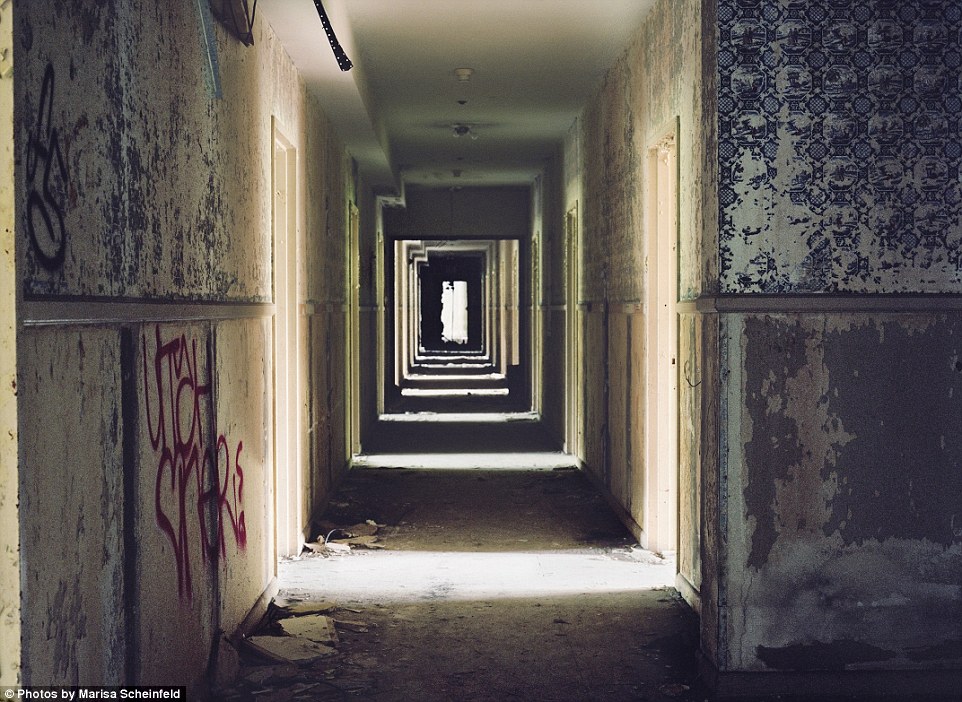
Walking through the haunting wreckage—thirsty swimming pools filled with garbage, and rows of hotel towers tagged by vandals—it’s almost impossible to believe that area was one of the most important vacation destinations in America for well over a century.


Grossinger's was the very first that introduced indoor swimming pools in the Catskills...


John Conway, the official Sullivan County historian, adjunct professor at SUNY Sullivan—and author of six books including Remembering the Sullivan County Catskills—dates the start of tourism in the Catskills to well before the Civil War, when tales of mammoth trout lured sport fishermen up to the region.

The advent of the railroad brought droves of vacationers at the end of the 19th century during what Conway refers to as the Silver Era, and for a while Sullivan County was an important destination where tuberculosis patients could convalesce.

In 1914, Selig Grossinger, a Jewish immigrant living in New York, moved his family to the Catskills in an attempt to cure his health issues caused by urban life. He bought a farm for $750, and quickly realized there was more money in renting rooms to summer boarders than there was in tilling the land.

After a fruitful year (earning $81 total) he expanded his enterprise. But Grossinger wasn’t alone, Conway notes. “By the 1920s the rise of big hotels took the Catskills by storm, almost all of which were exclusively Jewish.”

The sliver of Sullivan County that the newspapers dubbed the “Borscht Belt” was a haven for Jewish immigrants who were turned away from other holiday destinations.

In the Catskills they could eat kosher food, spend time with their extended families, and engage in the very American practice of vacationing, a pastime that didn’t exist in the Old Country.

As the popularity of these Jewish resorts continued to grow, many of the estates expanded to epic proportions, eschewing the appeal of the surrounding nature in favor of becoming a beached version of the modern-day cruise ship, offering everything anyone would need under one roof.

mayhem...

This is the Pine Hotel, but it might as well be the Grosssinger's, Kutsher's or the Nevele... fiber-glass galore to insulate against the bitter cold of winter-time in the mountains... 


the earth suddenly reclaimed its souls

Thousand-person theaters sprung up, and the casts of resident entertainers, which included the likes of Milton Berle (né Mendel Berlinger), Sid Caesar (né Isaac Ziser), and Alan King (né Irwin Kniberg), were largely credited with birthing American comedy as we know it today.

These summer havens were the training grounds for future television and film stars, and, as Conway explains, “It was the Saturday Night Live of its time, spawning the great entertainers of the ’30s, ’40s and ’50s—it was the Catskills’ Golden Era.” Even after the proliferation of TV, the major resorts would lure big-ticket names like Joan Rivers and Rodney Dangerfield for a night of laughs.

Sports, too, were an important part of the kingdoms of the Catskills. Basketball matches were orchestrated for entertainment purposes, and entire NCAA teams would take up residence at the different estates to hone their craft during the extended interim between semesters. “Wilt Chamberlain quite famously spent some time in the mountains, working as a bellboy at Kutscher's during the day and playing ball on the resort’s team in the evenings,” says Conway.

Sullivan County’s summertime influence on American sports and entertainment become such an important fixture in society that several films were created about the era. 

'Marjorie Morningstar', a 1958 WarnerColor melodrama romance film based on the 1955 novel of the same name by Herman Wouk. Directed by Irving Rapper and starred by Natalie Wood, Gene Kelly, and Claire Trevor, tells a fictional coming of age story about a young Jewish girl in New York City in the 1950s. The film's trajectory traces Marjorie Morgenstern's attempts to become an artist - exemplified through her relationship with the actor and playwright Noel Airman. 

The central conflict in the film revolves around the traditional models of social behavior and religious behavior expected by New York Jewish families in the 1950s, and Marjorie's desire to follow an unconventional path. The film is notable for its inclusion of Jewish religious scenes - including a Passover meal, a synagogue sequence and Jewish icons in the Morgenstern house. These depictions were one of the first times Jewish religion was portrayed overtly in film since The Jazz Singer in 1927. The movie received an Oscar nomination for Best Song ("A Very Precious Love"), sung by Gene Kelly.

29 years later,  'Dirty Dancing' (1987) became a blockbuster movie starring Jennifer Grey as the daughter of a wealthy Jewish family, and Patrick Swayze as a working-class dance instructor. The action takes place at the fictitious Kellerman’s, an idyllic world of holiday bliss, which, according to Conway, was “inspired by the real-life Catskills resorts like Grossinger’s.”
electric golf carts left to rot...


bus-boys' & waiters' uniforms...
The former coffee shop at Grossinger’s Catskill Resort Hotel in Liberty, N.Y., in  “Echoes of the Borscht Belt,” an exhibition of Marisa Scheinfeld’s photographs at the Yeshiva University Museum.Credit...Marisa Scheinfeld.
Grossinger's main building

The hotels were, for a couple of decades, truly magnificent, but Conway insists, “It was all built upon smoke and mirrors.” Behind the resorts’ veneer, unbeknownst to its guests, was a vicious game of one-upmanship that escalated with each passing summer.

“Each year the largest properties would unveil their latest gadget or gimmick to lure patrons back for the following season,” says Conway, the best example of which was the advent of the indoor pool. In 1958 Grossinger’s revealed a mammoth natatorium bedecked in a generous surplus of art deco detailing. Constructed at a huge cost, it forced the neighboring properties to take on a similar financial burden, and four years later there were over 30 indoor swimming pools in the region.

“Unable to recoup the insurmountable costs, the hotels struck lending deals with local vendors and banks,” says Conway, but the act of keeping up with the Joneses ultimately proved unsustainable, even for the hegemonies like Grossinger’s, and by the late ’60s most resorts had reached the point of no return.

Although the end was truly nigh by the end of the decade, rabid overspending wasn’t the sole conspirator in the demise of the Catskills' golden era. Conway refers to the other important factors as the “three ‘A’s”: air conditioning, assimilation, and airfare.

Sullivan County had long garnered a reputation as a place of wellness, often being quite literally what the doctor ordered for those unable to properly convalesce in the city, but the advent of air conditioning made it less of a necessity—especially for vacationers with smaller budgets—to escape the Big Smoke for breezier weather.

Dr. Phil Brown, a sociology professor at Northeastern University, founder of the Catskills Institute, and author of Catskill Culture: A Mountain Rat’s Memories of the Great Jewish Resort Area, cites the gradual melting away of anti-Semitism in America as “the primary reason for the decrease in the region’s Jewish clientele.”

As prejudices waned, it became easier and ultimately desirable for Jews to fully assimilate. Once other holidaying destinations around the country lifted their ban on Jewish patrons there was less of a need to coalesce in the Catskills, and as Brown says, “it became easier for young Jewish professionals to find jobs in the city,” meaning that they no longer needed to subsist on summer resort wages to fund their education.

But on a greater scale, the assimilation slowly chipped away at the tight family bonds formed long ago in the shtetls of Eastern Europe; a great number of American Jews intermarried with other faiths, and divorce became more commonplace in general. The younger generation, keen on being defined as American first before any other trait, saw little need to participate in Jewish activities as well.

“The broader acceptance of the nation’s Jewish population also led to a massive migration of Jews within America,” notes Brown. They left New York City for Los Angeles and Miami with the same spirit that led the previous generation over from the Old Country, as documented in Debra Dash Moore’s book, To The Golden Cities.

By 1970, Los Angeles held the world’s third-largest Jewish population after Tel Aviv and New York City, and few newly minted Californians saw the need for a forested holiday retreat when they were now living year-round in what Brown dubs “vacationland.”

For Brown, an increase in affordable airfare further encouraged American Jews to travel within the U.S. and beyond: “Jews were comfortable returning to Europe for holidays by the 1960s.” Brown believes that the all-inclusive structures of the Catskills hotels were the inspiration for the resort schemes in the Caribbean.

Suddenly, like a slap in the face, it seemed as though the Catskills were completely out of fashion. “It was so opulent that no one ever thought it would sink, then boom—it was gone,” says Conway. Although the majority of the 500-plus hotels have been rendered to ash, there are still a few places like Grossinger’s—a veritable college campus in size and scope—that stand silent amongst the encroaching weeds.

For some, the wreckage has become a tourist attraction in its own right, like traipsing through the Ukranian city of Pripyat, abandoned after the Chernobyl disaster. Multi-story hotel towers stand stripped of any ornamentation, and seem almost Soviet in their austere and honest decay. Tattered curtains flutter out the cracked windows, roofs collapse under the cruelty of weather and time, and empty hallways echo with the footsteps of curious trespassers.

At Kutsher’s, one of the last great resorts to bite the dust, a security officer stands guard, warning onlookers of the threat of asbestos within. Tractors have parked in front of the ruins.

Grossinger's Country Club... the Austrian Alps in the Catskills... 

Sorry, Ruins of Grossinger's Resort is permanently closed.

Until cheaper airfares made trips from New York to Miami more commonplace, the height of a luxury summer vacation for affluent Jewish New Yorkers in the 1950’s was to head up into the Catskills to one of the many holiday resorts.

Nicknamed the Borscht Belt, the jewel among the many competing vacation venues was the Grossinger’s Resort. Set in the hills around the small town of Liberty, New York, a review for the Commentary magazine in 1954, described Grossinger’s as “to resort hotels as Bergdorf Goodman is to department stores, Cadillac to cars, mink to furs, and Tiffany to jewelers … it has been called Waldorf in the Catskills.”

For decades, Grossinger’s was a by word in luxury. Over 150,000 people visited every year, entertained by the likes of Eddie Fisher, Jerry Lewis, and Milton Berle in the opulent nightclubs. The facilities were so state of the art (it was the first resort in the U.S. to offer artificial snow for year round ski runs) that Rocky Marciano used it as his training camp. The resort became the inspiration for Dirty Dancing. 

Grossinger’s started as a small family run hotel in 1917 owned by Austrian immigrants Asher and Malke Grossinger. But it was under their daughter Jennie Grossinger that the resort boomed. It soon spread to over 35 buildings covering 1,200 acres including its own private airfield. The main building contained an enormous dining room capable of seating 1,300 guests; under the dining room there was a vast, cavernous night club called the “Terrace Room.” The resort was so prestigious that Elizabeth Taylor married Eddie Fisher there. After Jennie died in 1972, the resort started to fall into decline. With guests choosing to fly elsewhere for the summer, the hotel closed its doors for the last time in 1986.

Since then it has been left to gradually fall into ruin. The Commentary magazine review noted that “the feeling one gets everywhere … is of pleasantly solid permanence.” But like Charles Foster Kane’s Xanadu, the pleasure palace of the 1950’s has gently been reclaimed by the forests of the Catskills. The outdoor tennis courts and swimming pools lie abandoned. The ice rink, hotel rooms, and golf pro’s clubhouses are covered in moss and ivy. The indoor swimming pool has turned into a living greenhouse. Where once guests in the high spirits of summer vacations dove off the high board, dined and danced the night away, there is now only the silence.

Update September 2018: Sadly, this abandoned borscht belt resort is being razed to make way for new development opportunities in Liberty, New York.

Asher Selig Grossinger moved from New York City to Ferndale in Sullivan County in the Catskill Mountains in the 1900s. There he rented rooms to visitors from New York City. His wife, Malke, operated the kosher kitchen, and Jennie Grossinger (1891-1972), his daughter, was the hostess. They called their home Longbrook House. In 1919, they sold it and purchased a bigger house on 100 acres, calling it Grossinger's Terrace Hill House.

During his fighting days Rocky Marciano would train at the resort. But in the late 1970s and 1980s, resorts like Grossinger's or the Concord could no longer attract younger guests.

In August 1984, Grossingers, in its dying years, promoted a Woodstock weekend to mark the 15th anniversary of the festival. It featured a workshop in tie-dyeing, a musical performance by David-Clayton Thomas, formerly of Blood, Sweat & Tears, a midnight showing of the four-hour documentary "Woodstock," and an appearance by John Sebastian, who advised, "Don't eat the purple tzimmes." Abbie Hoffman, who was thrown off the Woodstock stage by Pete Townshend of The Who for making a political speech, was brought in by Grossingers for the promotion.

In 1986, the Grossinger descendants sold the property to Servico. Grossinger's main hotel and main resort areas closed in 1986, but the golf course is still open as of 2014. The members of the golf clubhouse call the course "Big G". Servico failed to reopen the hotel due to the massive costs associated with it. Numerous other companies also failed the same feat. It is owned by Louis Cappelli as of September 2013, who is hoping for casinos to come to the area.
After the closing of Grossinger's at Liberty, N.Y. n 1985.

Liberty, N. Y., 22nd July 1964

Harry Grossinger, the man behind the scenes at one of the world's largest and best known resort hotels, Grossinger's of Sullivan County, died this afternoon of an acute coronary thrombosis at Maimonides Hospital here. His age was 76. He had been stricken in his quarters at the hotel early in the morning.

Conducted daily business

In the public eye, Mr. Grossinger was obscured by his wife, Jennie, who was the official hostess at the hotel. She is an outgiving person who probably knew and called more people by their first names than any full‐time politician. But intimates said it was Mr. Grossinger who actually ran the hotel, assisted in recent years by their son Paul as general manager.

Mr. Grossinger, for instance, did the buying for the hotel kitchen, going to New York's Washington Market twice a week in his chauffeur‐driven, custom‐built Continental limousine to inspect the vegetables and meat that would go into Grossinger's menus.

He also supervised the building of all the additions that had been raised during the last 50 years to the original seven-room farmhouse. He continued his activities even after a severe heat attack this year had sent him to a hospital in New York for several weeks.

Sunday, 14 June 2020

FALLSVIEW, Ellenville, N.Y.

Ellenville, N.Y. in the 1950s. 
The Nevele was just beside Fallsview; Nevele's glorious ground would dwarf Fallsview to nearly extinction... but apparently both resorts were owned by the same company: Ben Slutsky.